- KiwiSurf
- Lisbon surf forecast
- Costa da Caparica
Costa da Caparica surf forecast
Kiwi reads the Caparica coast four times a day and tells you the hour worth paddling out for. Free, hour by hour, in plain words.
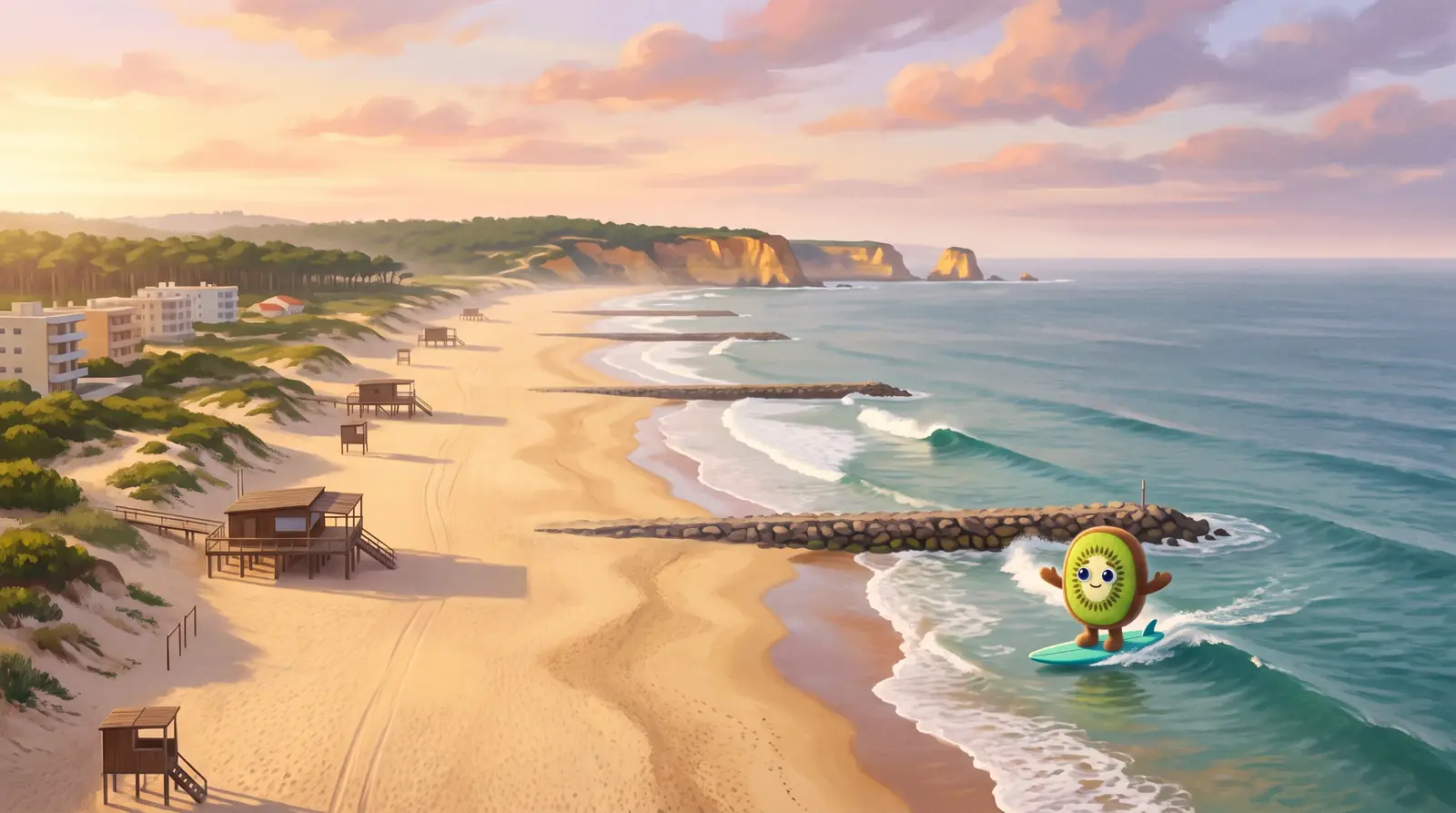
When to paddle out at Caparica
Every daylight hour for today and the next three days: wave height at the beach, swell period and direction, wind, tide and Kiwi's 1 to 10 rating. Green rows are the best window of the day.
Friday 30 October
Light 07:01 to 17:39
Go 15-16, clean chest-shoulder, glassy.
- 07:00 4 of 5 kiwis,8/10 0.9–1.2 m 3–4 ft 10 s WNW 10 NEoffshore 2.9 m ↓falling
- 08:00 4 of 5 kiwis,7/10 0.9–1.2 m 3–4 ft 10 s WNW 10 NEoffshore 2.3 m ↓falling
- 09:00 4 of 5 kiwis,7/10 0.9–1.2 m 3–4 ft 10 s WNW 10 NEoffshore 1.7 m ↓falling
- 10:00 4 of 5 kiwis,7/10 0.9–1.2 m 3–4 ft 11 s WNW 10 ENEoffshore 1.3 m ↓falling
- 11:00 4 of 5 kiwis,7/10 0.9–1.2 m 3–4 ft 11 s WNW 10 NEoffshore 1.2 m ↓falling
- 12:00 4 of 5 kiwis,7/10 0.9–1.2 m 3–4 ft 12 s WNW 9 NEoffshore 1.3 m ↑rising
- 13:00 4 of 5 kiwis,7/10 0.9–1.3 m 3–4 ft 12 s WNW 7 NEoffshore 1.6 m ↑rising
- 14:00 4 of 5 kiwis,8/10 1.0–1.3 m 3–4 ft 12 s WNW 5 ENEglassy 2.1 m ↑rising
- 15:00Kiwi's pick 5 of 5 kiwis,10/10 1.0–1.3 m 3–4 ft 13 s WNW 6 Eglassy 2.7 m ↑rising
- 16:00 3 of 5 kiwis,6/10 1.0–1.3 m 3–4 ft 13 s WNW 7 SSWcross-onshore 3.1 m ↑rising
- 17:00 2 of 5 kiwis,4/10 1.0–1.4 m 3–4 ft 13 s WNW 8 WSWonshore 3.3 m ↑rising
Saturday 31 October
Light 07:02 to 17:38
Go 07-10, clean overhead, offshore NE.
- 07:00Kiwi's pick 4 of 5 kiwis,8/10 1.5–2.1 m 5–7 ft 12 s WNW 7 NEoffshore 3.2 m ↓falling
- 08:00 4 of 5 kiwis,8/10 1.6–2.1 m 5–7 ft 12 s WNW 7 NEoffshore 2.8 m ↓falling
- 09:00 4 of 5 kiwis,7/10 1.6–2.1 m 5–7 ft 12 s WNW 8 NEoffshore 2.3 m ↓falling
- 10:00 3 of 5 kiwis,6/10 1.6–2.1 m 5–7 ft 12 s WNW 8 ENEoffshore 1.9 m ↓falling
- 11:00 3 of 5 kiwis,6/10 1.6–2.2 m 5–7 ft 12 s WNW 7 NEoffshore 1.5 m ↓falling
- 12:00 3 of 5 kiwis,6/10 1.6–2.2 m 5–7 ft 12 s WNW 5 ENEglassy 1.4 m ↓falling
- 13:00 3 of 5 kiwis,6/10 1.6–2.2 m 5–7 ft 12 s WNW 5 ENEglassy 1.4 m ↑rising
- 14:00 3 of 5 kiwis,6/10 1.7–2.2 m 5–7 ft 12 s WNW 5 SEglassy 1.7 m ↑rising
- 15:00 2 of 5 kiwis,4/10 1.7–2.2 m 5–7 ft 13 s WNW 7 SWonshore 2.1 m ↑rising
- 16:00 2 of 5 kiwis,4/10 1.7–2.3 m 6–8 ft 13 s WNW 8 WSWonshore 2.5 m ↑rising
- 17:00 2 of 5 kiwis,3/10 1.7–2.3 m 6–8 ft 13 s WNW 8 Wonshore 2.9 m ↑rising
Sunday 1 November
Light 07:03 to 17:37
Go 07-11, clean overhead, offshore ENE.
- 07:00Kiwi's pick 4 of 5 kiwis,7/10 1.6–2.1 m 5–7 ft 13 s WNW 10 ENEoffshore 3.3 m ↑rising
- 08:00 4 of 5 kiwis,7/10 1.6–2.1 m 5–7 ft 13 s WNW 10 ENEoffshore 3.2 m ↓falling
- 09:00 4 of 5 kiwis,7/10 1.6–2.1 m 5–7 ft 13 s WNW 11 ENEoffshore 2.9 m ↓falling
- 10:00 4 of 5 kiwis,8/10 1.5–2.0 m 5–7 ft 13 s WNW 10 ENEoffshore 2.4 m ↓falling
- 11:00 4 of 5 kiwis,7/10 1.5–2.0 m 5–7 ft 13 s WNW 9 ENEoffshore 2.0 m ↓falling
- 12:00 4 of 5 kiwis,7/10 1.5–2.1 m 5–7 ft 13 s WNW 6 ENEglassy 1.7 m ↓falling
- 13:00 4 of 5 kiwis,7/10 1.5–2.0 m 5–7 ft 13 s WNW 4 SEglassy 1.5 m ↓falling
- 14:00 3 of 5 kiwis,5/10 1.5–2.0 m 5–6 ft 13 s WNW 8 SWonshore 1.5 m ↑rising
- 15:00 3 of 5 kiwis,5/10 1.5–2.0 m 5–7 ft 13 s NW 8 WSWonshore 1.7 m ↑rising
- 16:00 3 of 5 kiwis,5/10 1.5–2.0 m 5–7 ft 13 s NW 7 WSWonshore 2.0 m ↑rising
- 17:00 3 of 5 kiwis,5/10 1.5–2.0 m 5–7 ft 13 s NW 7 Wonshore 2.4 m ↑rising
Monday 2 November
Light 07:04 to 17:36
Go 08-12, clean head-high, offshore ENE.
- 07:00 4 of 5 kiwis,8/10 1.3–1.7 m 4–6 ft 13 s NW 7 NEoffshore 3.1 m ↑rising
- 08:00Kiwi's pick 4 of 5 kiwis,8/10 1.3–1.7 m 4–6 ft 13 s NW 8 NEoffshore 3.2 m ↑rising
- 09:00 4 of 5 kiwis,8/10 1.3–1.7 m 4–6 ft 12 s NW 8 ENEoffshore 3.2 m ↓falling
- 10:00 5 of 5 kiwis,9/10 1.2–1.7 m 4–5 ft 12 s NW 8 ENEoffshore 2.9 m ↓falling
- 11:00 5 of 5 kiwis,9/10 1.2–1.7 m 4–5 ft 12 s NW 8 ENEoffshore 2.6 m ↓falling
- 12:00 4 of 5 kiwis,8/10 1.2–1.7 m 4–5 ft 12 s NW 5 ENEglassy 2.2 m ↓falling
- 13:00 4 of 5 kiwis,7/10 1.2–1.6 m 4–5 ft 12 s NW 4 ENEglassy 1.9 m ↓falling
- 14:00 4 of 5 kiwis,7/10 1.2–1.6 m 4–5 ft 12 s NW 6 WSWglassy 1.6 m ↓falling
- 15:00 2 of 5 kiwis,4/10 1.1–1.5 m 4–5 ft 12 s NW 10 WSWonshore 1.5 m ↓falling
- 16:00 2 of 5 kiwis,4/10 1.1–1.5 m 4–5 ft 12 s NW 11 WSWonshore 1.6 m ↑rising
- 17:00 2 of 5 kiwis,4/10 1.1–1.5 m 4–5 ft 12 s NW 9 Wonshore 1.9 m ↑rising
Forecast point: CDS / Praia do Norte (38.647° N, 9.242° W). Waves = estimated breaking height at the beach. Data: Open-Meteo wave and weather models (CC BY 4.0), corrected on buoys. Generated using E.U. Copernicus Marine Service Information (DOI 10.48670/moi-00043). Surf at your own risk.

The wind is the boss here. Caparica faces west-southwest, so a breeze from the east or north-east grooms the waves and anything from the sea messes them up. Check the wind column before the wave column.
Caparica, beach by beach
Almada's Atlantic side is a little over 13 km of unbroken sand, from the Tagus mouth to the fishing village of Fonte da Telha. From São João to Nova Praia, rock groynes cut it into bays: each one holds a sandbank and a peak, with a channel by the rocks for the paddle out. South of town the groynes stop and the beach opens up.
Cova do Vapor
ExperiencedBodyboardRight at the river mouth, and the heaviest wave on this coast: hollow wedges and low-tide lefts off the groynes, loved by bodyboarders. Not a place to learn.
São João
GroynesPaid parkingAbout 1.4 km of sand boxed in by groynes, with lefts and rights that like a west to north-west swell and an east wind. Guides disagree on the tide: some say all tides, others prefer mid to high.
Praia do Norte, Santo António and CDS
BeginnersSurf schoolsBusiestKiwi's forecast point and the classic place to learn: sandy bottom, soft whitewater and most of the lessons on the coast. CDS is also the competition beach, with lefts and rights between the jetties that work on every tide.
Fun fact: the council says CDS got its name in the late 1970s, when someone painted "Centro Desportivo de Surf" initials on a rock of its northern groyne.
Tarquínio-Paraíso, Dragão Vermelho, Praia Nova, Nova Praia
GroynesSurf FestThe town beaches, each one a bay between two groynes until the promenade ends at Nova Praia. Paraíso hosts the Caparica Surf Fest, a World Surf League qualifying event in 2025. Yes, Praia Nova and Nova Praia are two different beaches.
Saúde to Infante
No groynesQuieterSaúde, Mata, Riviera, Rainha, Castelo, Cabana do Pescador, Rei, Morena, Sereia and Infante: open beach with no groynes, so the sandbanks decide where it breaks. Surfers report Rainha and Castelo far quieter than town, and Castelo as fast and powerful. Quieter is not safer: one guide warns of strong rips at Rainha. Bus 3030 stops along the beach road.
Nova Vaga and Bela Vista
KitesurfFar from the crowds, and the council calls Nova Vaga a favourite for kitesurfing, so keep an eye out for lines and kites. The southern part of Bela Vista is a naturist beach.
Fonte da Telha
Kiwi forecasts itUnder the cliffsAlmost 3 km of beach under the Fossil Cliff, surfed all year. Kiwi rates it separately in the 06:00 call. After the 2025/26 storms, lifeguards reported a reshaped seabed and two new rip currents there (Lusa, June 2026). One road in, so expect summer queues.
What Caparica needs to fire
These are the exact rules behind Kiwi's rating for this spot. Every hour of the forecast is scored on all four, then turned into 1 to 10.
Swell
West to north-west, 9 s or longer
The forecast point faces west-southwest (the line in the dial). Swell from 240° to 310° walks straight in. Swell from north of west has to bend round Cabo Raso and over the Tagus sandbanks first, so the town beaches are partly sheltered from it.
Wind
Offshore from the east-northeast
Wind from about 40° to 110° blows offshore and holds the faces up. Under 6 km/h Kiwi calls it glassy, which is the dream. Light shades on the dial are cross-offshore: still fine.
Tide
Mid to high
Kiwi's rating prefers mid to high tide. Guides say CDS works on every tide: softer waves at high tide, hollower at low. At high tide the waves can break close to the rocks.
Size
Best at 0.9 to 2 metres
Waves start to work from about half a metre. Above 2 metres it gets heavy for the bays, and over 2.8 metres Kiwi says stay out.
Kiwi's shortcut: a westerly swell with a long period, an east wind and mid to high tide. When those three line up, the green rows show up in the table above.
The best months to surf Caparica
We replayed Kiwi's rating on every day from January 2025 to October 2026 and counted how often Caparica's best window reached 4 or 5 kiwis.
Sep · Oct · NovThe sweet spot
September and October are Caparica's best months: the best window reached 4 or 5 kiwis on 42% and 45% of days, and about 79% of days had a session worth 3 kiwis or more. November gets bigger and wilder (20%).
Dec · Jan · FebBig, often too big
Winter swells are often too big for the bays. The typical size at the day's best window was 3.4 m, and 15% of days made 4+ kiwis. The good ones come when a swell drops back into range and the wind turns offshore.
Mar · Apr · MaySettling down
The swell eases through spring, from about 2.5 m in March to 1.6 m in May at the best window. 31% of days reached 4+ kiwis and 57% had 3 or more.
Jun · Jul · AugSmall, friendly, early
Summer is small but usually surfable: 73% of days had 3 kiwis or more, good for learning. Go early: the best window started before 11:00 on 91% of summer days.
Before you go
Rips and lifeguards
Rip currents are the main hazard. They form beside the groynes, where they stay put and pull even in small waves, and on the open beaches too: one guide says they are especially strong at Rainha. Look for a darker, brownish channel with fewer breaking waves.
Lifeguards are on duty from 1 June to 30 September, and Almada's Praia Protegida programme adds safety cover outside the season. Emergencies: 112.
The orange-warning rule
Most forecast sites miss this one. When IPMA has an orange (or red) sea warning out, surfing at Caparica needs the Lisbon Port Captain's authorisation, and walking on the groynes is banned. Big swell days are exactly when this kicks in.
Getting there without a car
Driving and parking
15 to 40 minutes from central Lisbon over the 25 de Abril bridge. The toll is only charged northbound, on the way back (€2.25 for a car in 2026).
São João, Rainha and Rei have paid parking; the town beaches and Fonte da Telha have parking that is paid in summer. In spring and summer the council describes queues kilometres long.
Surf schools
By our count, the surf federation's registry has 39 school entries with an Almada postcode. A few of the schools teaching on this coast, in no order: ASCC, Dr Bernard, BIG Surf School, Caparica Surf School, Duckdive, Gecko, Caparica Surf Academy, Tiago Pires.
Crowds
The jetties in town (CDS) are the busiest part of the coast, and it thins out as you head south. Surfers' reports point to weekends as the busiest time, and one local guide says the middle of the day is the worst, so early and late sessions win.
Water and wetsuit
About 14 to 15 °C in late winter and about 18 °C in late summer and early autumn. The summer north wind pulls cold water up along the coast, so even August can feel fresh.
Typical advice: a 4/3 mm full suit with boots in the coldest months, a 3/2 in summer.
Webcams
KiwiSurf has no camera of its own yet. MEO Beachcam runs public cams along the Caparica coast (CDS, São João, Praia do Norte, Fonte da Telha and more), and Surftotal has one at Fonte da Telha.
New sand in 2026
One million cubic metres of sand from the Tagus channel were pumped onto the beaches from 2025 into June 2026, widening them by up to 40 m. Sandbanks move after works and storms, so watch a peak for ten minutes before you paddle out.
Where the numbers come from
The method
Kiwi starts from Open-Meteo's wave models (at Caparica: ECMWF WAM, Météo-France and Open-Meteo's own best-match blend; the GFS wave grid has no sea cell here) and corrects them with a model trained on past forecasts against Instituto Hidrográfico buoys, before anything else happens.
Then each hour at Caparica is scored on the four rules above (swell, wind, tide, size) and calibrated so that a 7 at Caparica means the same as a 7 at Guincho.
What we can prove
Measured on 30 days the model never trained on (29 September to 28 October 2026) at the offshore buoys. Not every week is better: in the last 7 days of that test, with big October swells, waves were 6% worse.
There is no buoy at Caparica, so the size at the beach is our model's estimate, not a measurement. See the full accuracy test.
Caparica surf questions
What is the surf like at Costa da Caparica today?
Kiwi's 13:00 run rates CDS / Praia do Norte 10/10 today, 5 of 5 kiwis: Go 15-16, clean chest-shoulder, glassy. Waves 1.0–1.3 m, 13 s swell from the WNW, wind glassy 6 km/h, tide mid rising. The hour-by-hour table above has every daylight hour for today and the next three days.
Is Costa da Caparica good for surfing?
Yes. It is all sand with no reef, the groynes in town keep the peaks well shaped, and it works on most west and north-west swells with an east wind. In Kiwi's replay of 2025 and 2026, September and October were the best months, with 4 or 5 kiwis on 42% and 45% of days.
Is Caparica good for beginners?
Very. Praia do Norte, Santo António and CDS are the classic place to learn: sandy bottom, soft whitewater, and it is where most lessons happen. Summer is the gentlest season (73% of summer days had 3 kiwis or more). Watch for rips beside the groynes and on the open beaches, and leave Cova do Vapor to experienced surfers.
When is the best time of year to surf Caparica?
September and October, in Kiwi's replay. Winter swells are often too big for the bays, spring settles down, and summer is small and best early: the best window started before 11:00 on 91% of summer days.
What wind and tide work best at Caparica?
An east to east-north-east wind blows offshore here, and under 6 km/h it is glassy. Guides say CDS works on every tide, with softer waves at high tide and hollower ones at low; Kiwi's rating leans to mid and high tide.
Is there a surf cam at Costa da Caparica?
Not from KiwiSurf yet. MEO Beachcam runs public cams along the coast, including CDS, São João, Praia do Norte and Fonte da Telha, and Surftotal has one at Fonte da Telha. A cam shows you now; Kiwi tells you which hour to go.
How do I get to Costa da Caparica from Lisbon without a car?
What is the water temperature at Costa da Caparica?
About 14 to 15 °C in late winter and about 18 °C in late summer and early autumn. In summer the north wind can pull cold water up along the coast, so it can feel colder than the season suggests. Typical advice: a 4/3 mm wetsuit with boots in winter and a 3/2 in summer.
Is Costa da Caparica windy?
Often in the afternoon. In summer the north wind (nortada) is strongest in the afternoon, which is why Kiwi's best summer windows started before 11:00 on 91% of days. An east or north-east breeze is offshore here and cleans the waves up.
Can you swim at Costa da Caparica?
Yes. In the bathing season (1 June to 30 September) Almada has lifeguards at 22 beaches along this coast. Swim at a lifeguarded beach. Rip currents form beside the groynes and on the open beaches too, so ask the lifeguards where it is safe.
Can I surf at Caparica during an orange sea warning?
Not without permission. While IPMA has an orange or red sea-state warning out, surfing in the Lisbon captaincy area (which includes Caparica) needs the Port Captain's authorisation, and walking on the groynes is banned.
How accurate is the KiwiSurf forecast?
On 30 days the model never trained on (29 September to 28 October 2026), it cut the wave height error by 8% and the wind speed error by 16% compared with raw Open-Meteo, measured at the offshore buoys. Not every week is better: in the last 7 days of that test waves were 6% worse. There is no buoy at Caparica, so the size at the beach is an estimate.
Is KiwiSurf free?
This page and the Telegram bot are free. Paid plans may include a 7-day free trial for new subscribers, and you always see the price before you pay.

Get Caparica in your 06:00 call
Tell Kiwi the waves you like and when you can surf. Every morning at 06:00 you get the sessions that fit you, Caparica included.