- KiwiSurf
- Lisbon surf forecast
- Guincho
Guincho surf forecast
Kiwi reads Praia do Guincho four times a day and tells you the hour worth paddling out for, before the wind gets there. Free, hour by hour, in plain words.
When to paddle out at Guincho
Today and tomorrow hour by hour from 05:00 to 21:00, then every 3 hours for two more days, rated 1 to 5 stars. Green-outlined rows are each day's best window.
08:00–12:00 · glassy
Today 31 Oct
Marginal 08-12: average, overhead, cross-shore N.
Best window: 08:00–12:00
Every hour, 05–21
Tide and daylight
- High
- 05:44 3.5 m
- Low
- 12:11 1.4 m
- High
- 18:26 3.1 m
- Sunrise
- 07:02
- Sunset
- 17:38
Tomorrow 1 Nov
Marginal 11-15: big for this spot, well overhead, glassy.
Best window: 11:00–15:00
Every hour, 05–21
Tide and daylight
- Low
- 00:28 1.6 m
- High
- 06:54 3.3 m
- Low
- 13:31 1.5 m
- High
- 19:48 3.0 m
- Sunrise
- 07:04
- Sunset
- 17:38
Monday 2 Nov
Worth it 08-12, clean overhead, glassy.
Kiwi's best shot: 08:00–12:00
Every 3 hours
Tide and daylight
- Low
- 01:49 1.7 m
- High
- 08:15 3.2 m
- Low
- 14:58 1.5 m
- High
- 21:15 3.0 m
- Sunrise
- 07:05
- Sunset
- 17:37
Tuesday 3 Nov
Worth it 10-14, fair chest-shoulder, cross-onshore NNW.
Best window: 10:00–14:00
Every 3 hours
Tide and daylight
- Low
- 03:19 1.7 m
- High
- 09:38 3.3 m
- Low
- 16:15 1.5 m
- High
- 22:27 3.1 m
- Sunrise
- 07:06
- Sunset
- 17:36
Forecast point: Praia do Guincho (38.732° N, 9.473° W). Waves = estimated breaking height at the beach. Data: Open-Meteo wave and weather models (CC BY 4.0), corrected on buoys. Generated using E.U. Copernicus Marine Service Information (DOI 10.48670/moi-00043). Surf at your own risk.

Beat the wind. Guincho faces west, so an east wind is offshore, while the summer north wind blows across the beach, often slightly from the sea. Check the wind column before the wave column, and on summer days look at the early rows.
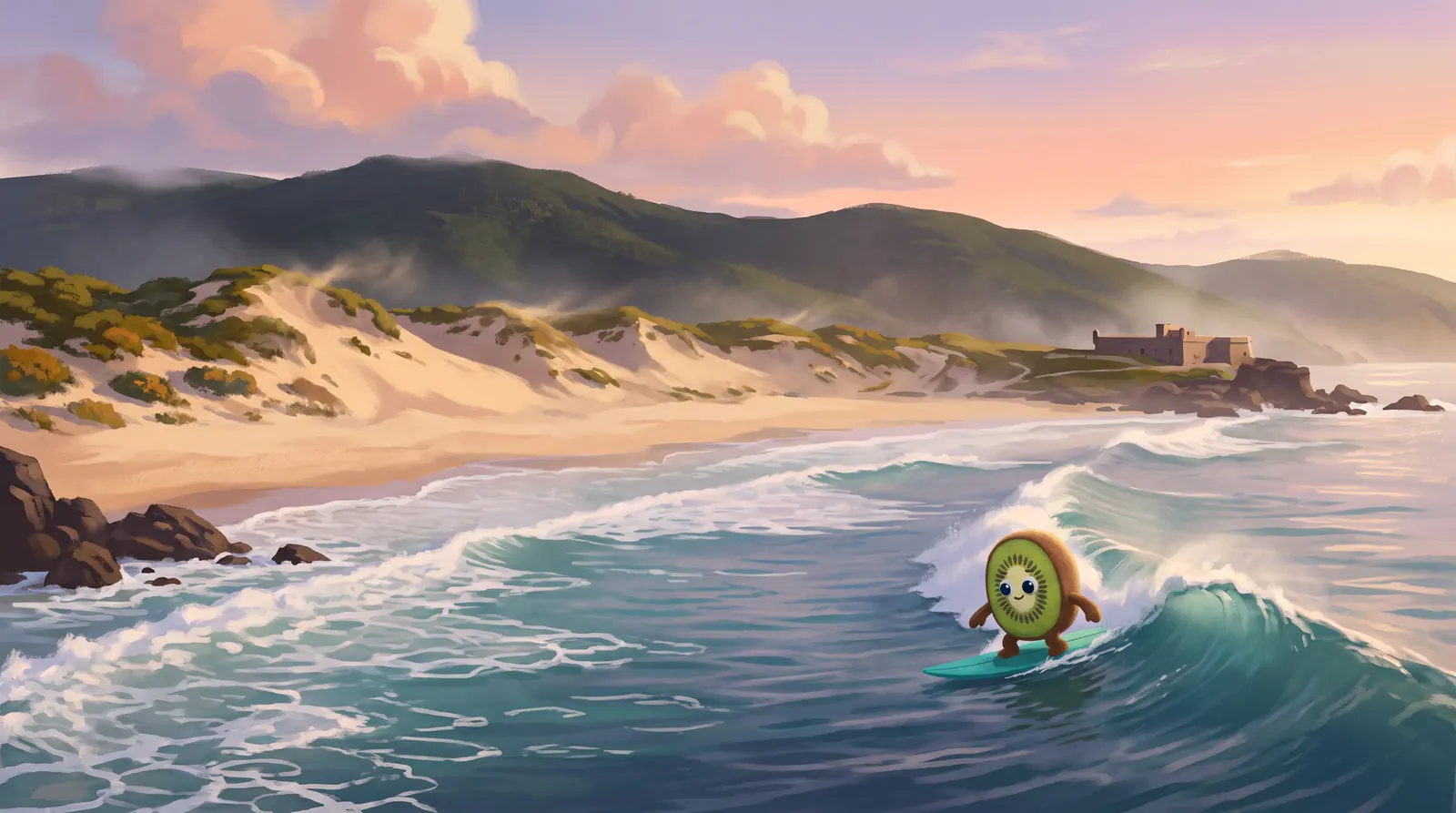
Guincho, end to end
Guincho is about 800 m of sand between two rocky points, Ponta Alta and Ponta do Abano, open to the Atlantic with the Serra de Sintra behind it. It is a beach break with no fixed peaks: the sandbanks move, so the best bank can turn up anywhere along the beach. Small coves sit at each end, Cresmina to the south and Abano to the north.
Praia da Cresmina
Lifeguards in seasonQuieterA small bay just south of Guincho, below the Cresmina dune, and quieter than its big neighbour. One guide describes sand with rocks and some reef, with lefts and rights that like a south-west to west swell and an east wind. Official lists also spell it Crismina.
Guincho Sul
Kiwi's forecast pointFort endThe south end, below the old fort that is now the Fortaleza do Guincho hotel. One guide says the south side often has a dependable left, with an A-frame building towards the middle.
Mind the rocks in the middle of the beach: the council describes a basalt outcrop, the remains of a volcanic chimney, that shows at low tide.
Guincho Norte
PowerfulBar and car parkThe north end. One guide says it takes the north-west swell most directly and gets the most power: hollow at mid to low tide on a solid swell, with a heavy shorebreak at high tide. Guides disagree on which end copes better with the wind.
One travel guide says you drive in by the Praia do Abano turn off the N247 and a dirt road to the car park.
Praia do Abano
No lifeguardsSmall coveA small cove past the north end. It is not on the 2026 bathing-water list, so there are no lifeguards, and no guide we found describes a surf break here. In August 2026 a surfer in trouble off Guincho was brought in by the Cascais lifeboat; one report says he had drifted out towards Abano.
What Guincho needs to fire
These are the exact rules behind Kiwi's rating for this spot. Every hour of the forecast is scored on all four, then turned into a rating of 1 to 5 stars.
Swell
West-southwest to north-west, 9 s or longer
Guincho faces west (the line in the dial). Swell from 245° to 315° walks straight in, and the beach takes almost the full open-ocean swell. That is why it has waves when the Cascais bays are flat, and why it maxes out first on big days.
Wind
Offshore from the east
Wind from about 65° to 135° (east-northeast to south-east) blows offshore and holds the faces up. Under 6 km/h Kiwi calls it glassy. Light shades on the dial are cross-offshore: still fine. The summer north wind is cross-shore to cross-onshore here.
Tide
Mid tide
Kiwi's rating prefers mid tide. Guides disagree: several like low to mid, others say any tide works, and high tide can bring a heavy shorebreak.
Size
Best at 0.9 to 2 metres
Waves start to work from about half a metre. Above 2 metres it gets heavy and the paddle out turns into hard work, and over 3 metres Kiwi says stay out.
Kiwi's shortcut: a west to north-west swell with a long period, a light east wind and mid tide, early in the day. When those line up, the green-outlined rows show up in the table above.
The best months to surf Guincho
We replayed Kiwi's rating on every day from January 2025 to October 2026 and counted how often Guincho's best window reached 4 or 5 stars.
Sep · Oct · NovThe sweet spot
September and October are Guincho's best months: the best window reached 4 or 5 stars on 17% of days in each, and 40% of October days had a session worth 3 stars or more. By November the swell is often too big again (typical best-window size 3.8 m).
Dec · Jan · FebMostly too big
Winter swells are usually too much for a beach this open. The typical size at the day's best window was 4.4 m, above the 3 m where Kiwi says stay out, and only 7% of days made 4+ stars. The good days come between storms, when the swell drops and the wind goes east.
Mar · Apr · MaySettling down
The swell eases through spring, from about 3.2 m in March to 2.1 m in May at the best window. April is the pick, with 4+ stars on 12% of days, and across spring 28% of days had 3 or more.
Jun · Jul · AugWind season
Summer swells are smaller and the north wind is in charge: even at the best window the wind was offshore, glassy or cross-offshore on only 21% of summer days. Still, 29% of days had a session worth 3 stars or more, mostly early: the best window started before 11:00 on 80% of days.
Before you go
Rips, rocks and lifeguards
Strong rips are the main danger here, worst in the deeper channels and when the swell is up, and the shorebreak can be heavy. Rocks in the middle of the beach show at low tide.
Lifeguards cover Guincho Norte, Guincho Sul and Cresmina from 1 May to 30 September, every day from 09:00 to 19:00; Abano has none. In August 2026 a surfer in trouble was rescued just after 19:00: the lifeguards were off duty but went in anyway, and the Cascais lifeboat brought everyone back. Emergencies: 112.
The yellow-warning rule
Most forecast sites miss this one. Under the Cascais port captaincy (Edital 950/2024), surfing, bodyboarding and SUP are banned whenever IPMA has a yellow (or higher) sea-state warning out, and allowed only from sunrise until one hour before sunset. Licensed athletes training with a coach are exempt.
In the bathing season, at lifeguarded beaches, surfers keep 150 to 300 m out or use the marked corridors, away from swimmers. Kiwi follows that rule: its windows end an hour before sunset and skip any hour under a yellow warning, and those hours carry a moon (☾) in the table.
The wind, and the kites
Guincho and Guia get the strongest winds in Cascais. The council's environmental study explains why: north winds speed up as they pour down the Serra de Sintra, then meet hot sand and the wind wrapping round Cabo da Roca. On nortada days it blows anywhere from about 10 to 72 km/h.
That wind made Guincho a windsurf venue: the World Cup came in the 1990s and the PWA wave tour in 2005, 2006 and 2007. Kites and windsurfers may sail up to force 7, never under a yellow sea warning, and in the season must stay 300 m off the lifeguarded beaches. The gusts make it a spot for intermediate and advanced riders.
Getting there without a car
- Cascais-line train from Cais do Sodré to Cascais: about 40 min.
- From Cascais station, MobiCascais bus M43 (Circular Guincho) follows the coast road to Praia do Guincho in about 26 min. It leaves at a quarter past 08, 09, 10, 11, 14, 15, 17, 18 and 19 h, every day.
- Buses M05 and M15 also loop from Cascais station via Guincho; M15 runs about every hour.
- Or cycle the Ciclovia do Guincho: about 9 km along the sea from Cascais Marina.
Driving and parking
About 40 minutes to an hour from central Lisbon: the A5 to Cascais, then the Guincho road (N247), or over the hills on the N9 from Malveira da Serra. Guincho is about 8 km from Cascais.
There are car parks at both ends of the beach and spaces along the road. Sources disagree on what they cost in summer, so check the signs, and on sunny summer days get there early.
Surf and kite schools
A few of the schools teaching at Guincho, in no order: Moana, Shaka, Salty Souls, South Adventures; for kitesurf, SBKiteboarding. Under the captaincy rules a surf coach can take at most six students in the water.
Crowds
One guide says the middle of the beach fills with surf schools on summer days, with more room a little to the north or south, and that winter lineups are mostly experienced surfers. Early sessions also beat the wind.
Water and wetsuit
About 14 to 15 °C in late winter and about 18 °C in September and October. The summer north wind pulls cold water up along the coast, so August can feel cold too.
Typical advice: a 4/3 mm full suit in winter and a 3/2 once the water warms up.
Webcams
KiwiSurf has no camera of its own yet. MEO Beachcam has a public cam on the south end (Guincho Sul), and Surftotal has one at Guincho Norte.
Natural park and dunes
Guincho sits inside the Sintra-Cascais Natural Park, and the Guincho-Cresmina dunes behind it are alive: north-west winds carry the sand south-east over Cabo Raso and back into the sea. Cross them on the boardwalks that start at the council's Cresmina dune centre.
In 2012 Guincho won the sports-beach category of the 7 Wonders of Portugal beach vote. Film fans: the opening scene of the 1969 Bond film On Her Majesty's Secret Service was shot here. And one author traces the name to the osprey, once called guincho in Portuguese.
Where the numbers come from
The method
Kiwi starts from Open-Meteo's four wave models (ECMWF WAM, Météo-France, NOAA GFS-Wave and Open-Meteo's own best-match blend). ECMWF's grid cell nearest Guincho is land, so Kiwi takes ECMWF from a sea cell a little further out (38.75° N, 9.75° W). Then it corrects them with a model trained on past forecasts against Instituto Hidrográfico buoys, before anything else happens.
Then each hour at Guincho is scored on the four rules above (swell, wind, tide, size) and calibrated so that 4 stars at Guincho mean the same as 4 stars at Carcavelos.
What we can prove
Measured on 30 days the model never trained on (29 September to 28 October 2026) at the offshore buoys. Not every week is better: in the last 7 days of that test, with big October swells, waves were 6% worse.
There is no buoy at Guincho, so the size at the beach is our model's estimate, not a measurement. See the full accuracy test.
Guincho surf questions
What is the surf like at Guincho today?
Kiwi's 07:56 run gives Guincho 2/5 stars today: Marginal 08-12: average, overhead, cross-shore N. Waves 2.0–2.7 m, 12 s swell from the WNW, wind cross-shore N 9 km/h, tide high falling. The table above has today and tomorrow hour by hour from 05:00 to 21:00 and the two days after every 3 hours.
Is Guincho good for surfing?
Yes, if you can handle it. It is an open beach break that picks up swell when the Cascais bays are flat, and it is at its best on a west to north-west swell with a light east wind. It is often too big in winter and too windy on summer afternoons, though: in Kiwi's replay of 2025 and 2026 the best months, September and October, reached 4 or 5 stars on 17% of days in each.
Is Guincho good for beginners?
Not usually. Strong rips, a heavy shorebreak and the wind make it a beach for intermediate surfers and up. On small summer days surf schools do teach beginners in the whitewater on the inside, so if you are learning, come with a school.
When is the best time of year to surf Guincho?
September and October, in Kiwi's replay. Winter swells are mostly too big (a typical 4.4 m at the day's best window), spring settles down, and summer is smaller and windy: the best window started before 11:00 on 80% of summer days.
Is Guincho windy?
Very. Guincho and Guia get the strongest winds in Cascais: north winds speed up as they come down the Serra de Sintra and meet the wind wrapping round Cabo da Roca, and on nortada days it blows from about 10 to 72 km/h. In summer the north wind builds from early afternoon; even at Kiwi's best summer windows it was offshore, glassy or cross-offshore on only 21% of days. An east wind is offshore here. For today's best window, Kiwi's 07:56 run expects a cross-shore N wind: 9 km/h, gusts 19 km/h.
Can you kitesurf or windsurf at Guincho?
Yes, it is one of the best-known wind spots near Lisbon: it hosted the windsurfing World Cup in the 1990s and PWA wave events in 2005, 2006 and 2007. The summer north wind is strong and gusty, so it suits intermediate and advanced riders. Captaincy rules: up to force 7, never under a yellow sea warning, and in the bathing season at least 300 m off the lifeguarded beaches.
Is there a surf cam at Guincho?
Not from KiwiSurf yet. MEO Beachcam has a public cam on the south end, and Surftotal has one at Guincho Norte. A cam shows you now; Kiwi tells you which hour to go.
How do I get to Guincho from Lisbon without a car?
Take the Cascais-line train from Cais do Sodré to Cascais (about 40 min), then MobiCascais bus M43 along the coast to Praia do Guincho (about 26 min), or the M05 and M15 loops. You can also cycle the 9 km Ciclovia do Guincho from Cascais Marina.
What is the water temperature at Guincho?
About 14 to 15 °C in late winter and about 18 °C in September and October. In summer the north wind can pull cold water up along the coast, so it can feel colder than the season suggests. Typical advice: a 4/3 mm wetsuit in winter and a 3/2 once the water warms up.
Can you swim at Guincho?
With care, and at a lifeguarded beach: Guincho Norte, Guincho Sul and Cresmina have lifeguards from 1 May to 30 September, 09:00 to 19:00. Rips and a heavy shorebreak make Guincho a rough beach for swimming, and Abano has no lifeguards. Emergencies: 112.
Can I surf Guincho during a yellow sea warning?
No. Under the Cascais port captaincy, whose area covers the beaches of Cascais, Sintra and Mafra, surfing, bodyboarding and SUP are banned while IPMA has a yellow or higher sea-state warning out, and allowed only from sunrise to one hour before sunset. Licensed athletes training with a coach are exempt.
How accurate is the KiwiSurf forecast?
On 30 days the model never trained on (29 September to 28 October 2026), it cut the wave height error by 8% and the wind speed error by 16% compared with raw Open-Meteo, measured at the offshore buoys. Not every week is better: in the last 7 days of that test waves were 6% worse. There is no buoy at Guincho, so the size at the beach is an estimate.
Is KiwiSurf free?
This page and the Telegram bot are free. Paid plans may include a 7-day free trial for new subscribers, and you always see the price before you pay.

Get Guincho in your 06:00 call
Tell Kiwi the waves you like and when you can surf. Every morning at 06:00 you get the sessions that fit you, Guincho included.